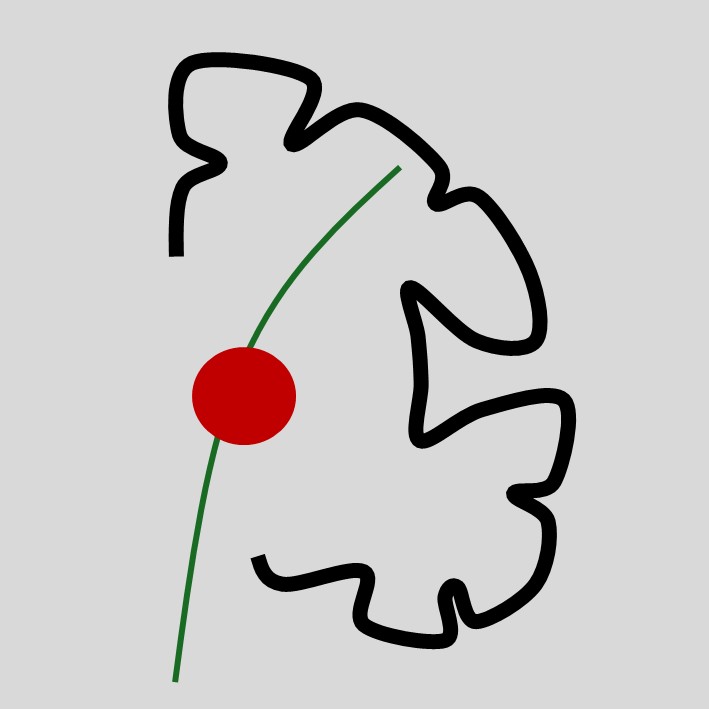
Case 23 - Weakness and abnormal eye movements
What is the lesion?
This lesion was sudden-onset and evolved rapidly, with coma developing in less than an hour from onset. It is almost certainly vascular - little else would come on this quickly. Mass lesions can sometimes cause sudden deterioration due to hydrocephalus, particularly if the fourth ventricle is obstructed, but it seems unlikely the patient would be entirely asymptomatic before this, and hemiplegia would be unusual.
Both ischaemic and haemorrhagic stroke could present this way. The ventral pons can develop infarction from occlusion of the paramedian vessels, and the same vessels can rupture leading to haemorrhage.
It's less common to see rapid deterioration to coma in pontine ischaemic strokes. However, basilar artery thrombosis can initially affect the pons then lead to coma as the thrombus migrates upwards to the basilar tip. Miller-Fisher described this as 'herald hemiparesis' in 1988 - unilateral weakness preceding bilateral signs and coma as the thrombus ascends, initially affecting the pons and then midbrain and thalamic structures involved in consciousness.
On the other hand a pontine haemorrhage could easily produce coma due to a rapidly-expanding haematoma - affecting the reticular activating systems and extending upwards into the midbrain. Pontine haemorrhage is very dangerous - if there is coma the chances of survival are minimal.
It is also possible that the patient has an ischaemic or haemorrhagic stroke elsewhere leading to high ICP and a false-localising VI then coma. Of the two, haemorrhagic stroke is more likely, but it would have to be large. If within the hemisphere, the coma usually follows massive herniation - and the classic marker of this is not VI palsy but III palsy, as the temporal lobe uncus herniates over the tentorial edge (see Case 14 ). It seems less likely somehow that the VI is false-localising here given the acuity of everything developing all at once. A single pontine lesion fits very neatly.
This can lead to rapid-onset coma and sometimes has focal signs accompanying it. VI palsy could be seen due to high ICP. However the situation here isn't a typical presentation of SAH - the patient had no headache, the classic feature, and sudden-onset hemiplegia is unusual.
CVST is often associated with VI palsy due to raised ICP. The presentation is usually severe headache, which this patient didn't have. It's not common to see sudden-onset hemiplegia in CVST however, nor coma - deep site thrombosis in the internal cerebral veins can affect the thalamus causing coma but hemiplegia would be unusual. When it develops it's often a complication of haemorrhagic transformation of venous infarctions in the cortex, which takes some time to emerge.
The typical evolution of features due to CNS tumours is gradual, but sometimes they present abruptly.
Occasionally, tumours present in a stroke-like manner, with no preceding symptoms then sudden-onset of deficits. This is often due to the massive development of cerebral oedema, which may reach a 'critical mass' and compromise structures, typically in the cortex.
Tumours can also cause seizures, with sudden-onset of post-ictal deficits and drowsiness. They can also bleed, causing an intracranial haemorrhage, again manifesting like a stroke. Finally they may obstruct CSF channels, especially the fourth ventricle - causing rapid deterioration with hydrocephalus (typically with headache, vomiting and reduced consciousness).
It's less likely that this is a tumour - to go from no symptoms and totally well to sudden hemiplegia and VI palsy, then rapid deterioration (minutes) to coma, is an unusual trajectory.
Inflammation and infectionThe brainstem is a vulnerable site for inflammatory brainstem lesions, but this doesn't seem likely.
It's a common target in multiple sclerosis, but almost never this fulminantly, and the features are typically more limited. Likewise other neuroinflammatory diseases such as neuromyelitis optica can affect the brainstem but such a fulminant course is very unusual.
Brainstem encephalitis has many causes including infections (such as Listeria and Enterovirus) or autoimmune causes including the Bickerstaff variant of Guillain-Barré syndrome. While these might cause focal deficits and altered consciousness they wouldn't present this rapidly. Behçet’s disease can cause midbrain lesions but the pons is not the typical site. The anti-Ma2 paraneoplastic syndrome usually affects the midbrain and hypothalamus, causing ophthalmoplegia and narcolepsy.
CLIPPERS (chronic lymphocytic inflammation with pontine perivascular enhancement responsive to steroids) is an inflammatory disease which affects the pons - but the tempo is far slower.
Toxic and metabolicToxic and metabolic brainstem insults exist but are not likely here.
The most feared is osmotic demyelination which tends to affect the central pons. This comes on amid osmotic fluid shifts, especially with rapid correction of chronic hyponatraemia. It can cause paralysis, including bilateral, with ophthalmoplegia and anarthria - the 'locked-in' state. Here there is nothing to suggest any vulnerability to this, and the onset is so rapid it doesn't seem likely.
Wernicke's encephalopathy involves the apical brainstem causing ophthalmoplegia as well as ataxia and also affects structures involved in cognition, but doesn't present in this manner.
Neurodegenerative diseasesA range of neurodegenerative diseases affect the brainstem, for example Parkinson's and progressive supranuclear palsy, causing problems such as rigidity, bradykinesia and eye movement disorders, as well as motor neuron disease, causing weakness and bulbar issues. However, this is clearly not neurodegenerative - the tempo would be vastly slower than this (months-years), and it's rare to see such a focal and lateralised pattern.
This is very likely to be a vascular lesion in the right, central pons - one capable of rapid deterioration to coma. A pontine haemorrhage seems most likely, while basilar artery thrombosis is a consideration too.
Clinical formulation