Case 24 - Dizziness and slurred speech
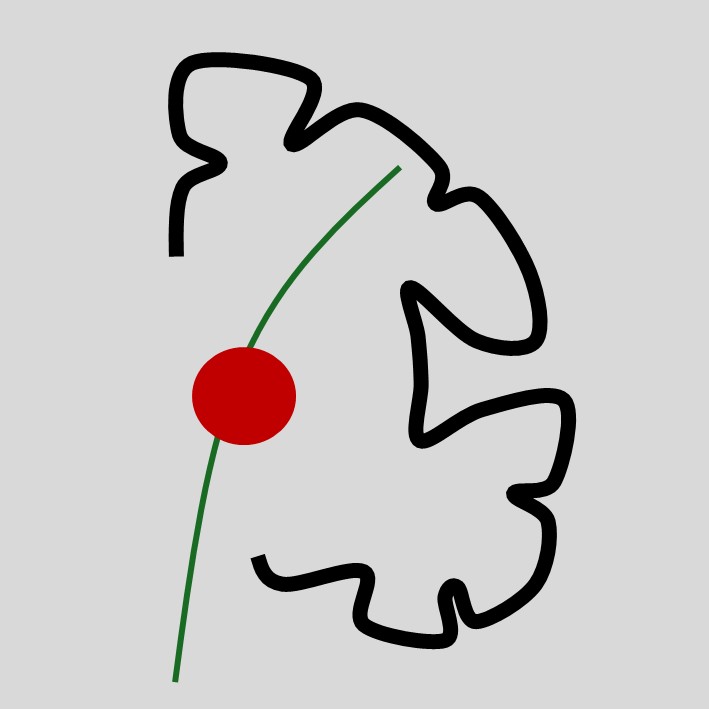
What is the lesion?
The onset of this was sudden and it peaked quickly then subsided, leaving more mild but persistent features.
There is a differential diagnosis to consider. Stroke seems most likely but we should think about alternatives.
It's difficult to think of this as being anything other than vascular, although it's always good to have a differential, even for clinically probable strokes. Many potential strokes turn out to be 'mimics' - other conditions that look stroke-like.
A stroke is highly likely in this case. It is not likely to be haemorrhagic, because it improved so quickly - a posterior circulation haemorrhage is often a major event and blood does not tend to have transient, peaking effects and then improve as fast as this.
An ischaemic lesion is most likely.
If everything had resolved fully this would be suggestive of a transient ischaemic attack (TIA) – but his symptoms and signs do persist, just more mildly. This makes a stroke, not TIA, the likely culprit if this is vascular. We do see ischaemic strokes cause an initial peak of symptoms which then settle to a more minor level.
If this is a stroke it’s in the posterior circulation-supplied territory, and most likely in the upper central and right cerebellum given the speech involvement – in the rostral paravermis area supplied by the superior cerebellar artery (SCA). It’s not impossible that instead it’s in the brainstem but the features do not suggest this.
The other condition that presents then resolves in this timeframe is migraine with aura. It's the aura part that accounts for migraine being such an enormous stroke and TIA mimic - arguably the biggest.
Aura is due to spreading depression, mainly in the cortex, causing lateralising problems such as aphasia, visual or sensory disturbance and hemiparesis. An uncommon form affects brainstem functions and causes features resembling this case, such as dysarthria, vertigo, diplopia, ataxia or altered consciousness - and even coma. Migraine can cause dramatic presentations beyond headache and is very common in acute neurology.
Migraine with brainstem aura is possible here but various features make it less likely.
Headache, or its absenceThis patient did not have a headache. Not all migraine aura episodes feature this, though most do. Its absence doesn't rule it out, nor would the presence of headache make migraine the definite cause here. However, along with some other features, it makes migraine less likely.
Onset, evolution and durationThe timeline of symptoms tells us more about aetiology than anything else.
While migraine can cause sudden-onset features, this is atypical - they tend to evolve over minutes, for example weakness building in intensity to full hemiplegia.
However, this may not be the case with brainstem aura. Vertigo of any cause is often sudden-onset - if one side of the vestibular system falters for any reason, this immediately upsets tonic input between sides, making the brain think the head is rotating, and sudden vertigo can follow. This can be severe at onset rather than mild and building up.
In migraine with multiple different aura symptoms, they often succeed each other - one resolves as another develops. This is typical with cortical features (visual aura, sensory disturbance and dysphasia), but not always with brainstem aura - the spreading depression does not have to travel far to involve adjacent structures.
Aura typically resolves within an hour, but not always. Weakness and vertigo are the longest aura forms - often lasting hours or days, micking other disorders.
Here though, the persistent gait ataxia after the event has largely resolved is hard to attribute to migraine - it would be a strange after-effect - and far more concerning for a structural cause.
Previous episodes - or notMigraine tends to be a recurrent issue and is often stereotyped for individuals. A previous history of migraines is helpful as it might make migraine a more likely consideration when we see a patient with new symptoms, though obviously there is a differential to consider - especially if symptoms are different to prior ones.
It would also be unusual to have this attack at age 49 without any previous episodes. People can have a migraine for the first time at any age, but we shouldn't jump to this assumption.
This is probably not migraineTo conclude - the lack of headache, the explosive onset, the lack of sucecssive evolving features, the ongoing ataxia, and lack of prior history aged 49 all make migraine less likely.
Toxic and metabolic disorders frequently affect the cerebellum, often causing vertigo, ataxia and dysarthria. The cerebellum is a major component of the nervous system, and is metabolically active, vulnerable to disruption. It's also a GABA-heavy system so anything potentiating GABA-ergic transmission, particularly sedating drugs, can affect it.
Few toxic or metabolic conditions would peak and resolve so briefly, leaving only a degree of gait ataxia. The main toxic cause that does fit this timescale is peak-dose toxic effects of anti-seizure medications such as carbamazepine, but the patient isn't taking any.
The lateralising features reported are also atypical for toxic and metabolic causes of cerebellar disease.
The cerebellum and brainstem are a frequent target in inflammatory and infectious disorders - we've seen this in earlier cases.
This is a broad topic, including demyelinating disorders, brainstem encephalitis (e.g. Listeria), cerebellitis (e.g. after Varicella), abscesses, paraneoplastic disorders and prion disease (ataxia is common in CJD). However, the rapid onset and quick improvement are not in keeping with any infective or inflammatory cause for this presentation.
A mass lesion is even less likely - the symptoms peaked then largely resolved, with only minor residual effects. This isn't consistent with the usual progression of tumours, which cause progressive features unless they are removed.
There is one rare but important cause of transient vertigo and ataxia worth mentioning - dynamic obstruction of the fourth ventricle by a mobile intraventricular mass (Bruns' syndrome). The major cause is neurocysticercosis, although tumours can also cause it. Attacks are triggered by head movements and can affect consciousness. This seems unlikely here but not impossible.
Seizures can rarely cause vertigo (epileptic vertigo) but this is typically very brief, lasting seconds - the attack was far too long. Further seizure features may then emerge, including generalisation, but this didn't happen here. Seizures can leave people with post-ictal deficits, particularly in speech or with unilateral weakness, mimicking stroke, but truncal ataxia is unusual.
We should discount seizure at this point.
It's worth considering functional disorders as a cause for most acute neurological problems, as in this case. Functional disorders can cause dizziness, imbalance and speech changes, so could this be functional?
Diagnosis requires showing inconsistency - features that show the system is intact but there is a problem with autonomy or 'agency' over it. for example inability to generate force in a leg despite the ability to do so in compound bilateral actions (the basis of Hoover's sign). We should be careful as structurally-mediated conditions can also interfere with agency, for example apraxia or neglect. Other disorders can fluctuate, appearing 'inconsistent' across the assessment - for example neuromuscular junction problems.
The other key feature is incongruence with other conditions, although some experts discourage this due to hazards - for example unfamiliarity with a structurally-mediated condition accounting for a presentation, leading to the wrong assumption the issue must be functional, a common pitfall.
The dizziness seen with functional disorders is often of a floaty/dreamy type, not violent rotation. Dysarthria is characteristic: slow, effortful and with stammering, the latter not common in structurally-mediated ('organic') conditions. Altered gait and balance are common and are characteristic, e.g. dragging a leg or a cautious, stiff, 'walking on ice' gait. Subtle impairment of tandem gait is not typical.
Lastly, the evolution and resolution here are atypical. Functional neurological episodes are rarely brief - and it's unusual for the symptoms to have largely resolved on arrival. Attacks are disabling and often prolonged.
In this case, there was no inconsistency, his condition is congruent with structurally-mediated disorders (particularly stroke) and did not resemble functional presentations, and the short duration and near-resolution with only minor residual features, are all strong pointers away from a functional disorder.
He needs urgent imaging. A CT scan is important in the emergency setting as there are a range of possible causes, a number of which - haemorrhage, tumour - will likely be visible. However, for ischaemic stroke, CT head lacks sensitivity, so a negative scan does not 'rule it out' - if no alternative cause is seen then a CT-negative stroke seems likely and we should work up and treat for this pending a more sensitive MRI.
If this does turn out to be a stroke, we then need to think about why he had this.
At 49 he is 'young' from a stroke perspective, which means the likely cause will be different to the usual causes in older people. Of course, he may simply have accelerated atherosclerosis, but this feels unlikely - diet-controlled high cholesterol doesn't seem enough.
Key considerations in young-onset stroke include the following: